
The study of Feng Shui emphasizes "clear rules, defined boundaries, and verifiable results." This article is based on classics, outlines the principles of landforms, techniques of Qi, and the essence of Xuan Kong, combined into a universal guide for practical operation and verification.
1. Classic Origins and Principle Foundations
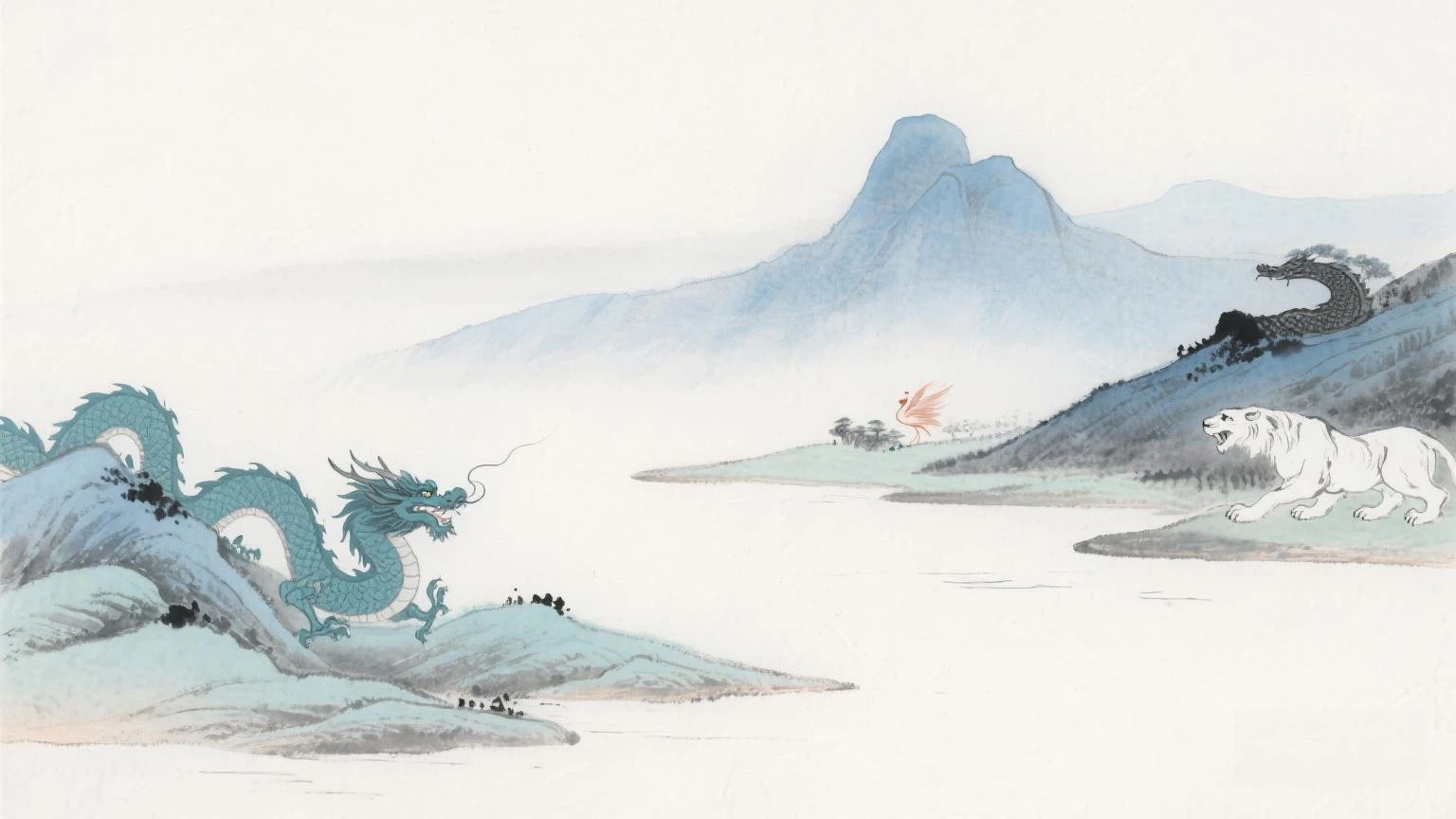
1) Key points of the "Yellow Emperor's Classic of Residence": The harmony of human dwellings and the universe is governed by Tai Chi Yin Yang, the Three Talents and Four Symbols, and the Five Elements and Eight Trigrams, emphasizing site selection, orientation, timing, and the configuration of "Left Green Dragon, Right White Tiger, Front Vermilion Bird, Back Black Tortoise," advocating for "mountains surrounding and water embracing, with Qi gathering and not dispersing." (Summary of ancient texts)
2) Core of the "Book of Burial": Based on "riding the life Qi and hiding the wind to obtain water," it explains the standards of landforms, the Four Gods Sand, and soil quality, proposing that "Qi responds to feelings, and ghostly blessings extend to people," with five prohibitions on burial: children, severed, stone, excessive, and solitary. (Summary of ancient texts)
3) Essentials of the "Classic of Dragon Movement": The Nine Stars Dragons (Greedy Wolf, Giant Gate, Prosperity, Literary Star, Integrity, Martial Star, Breaking Army, Left Assistant, Right Companion), methods to identify dragons include both mountains and plains, particularly emphasizing "peeling and changing" and water verification, with the standard for identifying dragons in plains being "the true dragon is where two waters meet." (Summary of ancient texts)
2. Landform Rules (Form First)
- Complete Four Gods Sand, appropriate case mountain, open hall layout, and constrained water mouth, emphasizing "hiding wind and gathering Qi."
- Urban environment analogy: roads as water, buildings as mountains, bridges as passes; high-rise residences should determine positions based on the "main Qi mouth" (door, balcony, commonly used windows).
- Judgment guidelines: first look at Qi collection and gathering, then at protective sand and incoming dragons, finally focusing on the specific arrangement of the main door hall, master bedroom, and stove position.
3. Eight Mansions Rules (Simple Qi Method)
- The East Four Mansions and West Four Mansions match with life trigrams, with four auspicious positions: Life Qi, Extended Year, Heavenly Doctor, and Hidden Position; four inauspicious positions: Fatality, Five Ghosts, Calamity, and Six Killings.
- The three essentials of door, master, and stove should be prioritized, ensuring "the door is prosperous, the master is calm, and the stove is positioned well."
- The judgment methods for hidden positions vary by life, sitting, door, and floor, and when applying, the boundaries of the methods used must be clear to avoid confusion.
- In modern small spaces and shared living scenarios, the Eight Mansions should prioritize "simplicity, stability, and ease of execution," and when member life trigrams conflict, space allocation should consider primary and secondary spaces along with dynamic and static attributes.
4. Xuan Kong Flying Stars Rules (Refined Qi Method)
- The Three Cycles and Nine Periods with Nine Palaces align with stars, using the correct needle to determine the Twenty-Four Mountains. Start with the "three plates"—the movement plate, mountain plate, and direction plate, according to the sitting direction and the period entering the center to fly the arrangement.
【Insert illustration location|Figure 2: Twenty-Four Mountains Correct Needle Compass Ring】
- Key rules:
1) Zero Correct God and Water Mouth determine the situation: "Correct God in the correct position, directing water into the zero hall," with mountain stars being prosperous when seen on mountains, and direction stars being prosperous when seen on water as auspicious, avoiding "mountain dragon gods not descending into water, and water dragon gods not ascending mountains."
【Insert illustration location|Figure 5: City Gate Formula and Water Mouth Determination】
2) Double Stars to Direction (Seven Stars Robbery): The direction must see beautiful water, and there should be a case outside the water; the back mountain should not be too high, allowing wealth to flourish without harming the family; the environment is key to forming the situation.
【Insert illustration location|Figure 3: Nine Palaces Flying Stars Illustration (Eight Periods Sub-Mountain Noon Direction)】
3) Combined Ten Method and Communication Trigram: If not a prosperous mountain and prosperous direction situation, it can be remedied by "two numbers in the palace combining to ten" to communicate Qi, separating the uses of slightly prosperous family and slightly prosperous wealth.
【Insert illustration location|Figure 4: Combined Ten Method Communication Trigram Diagram】
4) Annual Flying Stars: The stars entering the center can use the formula "11 - the sum of the four digits of the year"; the divergence of forward and reverse flying—"Shen's Method (always forward flying)" and "Luo Qian's Method (according to the New Year's plate three cycles of dragon Yin Yang, Yang forward and Yin reverse)," in practice, prioritize those corresponding to the dwelling direction.
5) Main and Guest Stars Meeting and Five Elements Generating Killing: Based on generating in, generating out, killing in, killing out, and comparing and harmonizing five patterns to judge relationships, it is necessary to have "Qi mouth controlling the dwelling" (people flow and wind flow promoting prosperity), typical combinations like two five killing, two three bull fighting killing, etc., must be combined with landform verification.
【Insert illustration location|Figure 6: Two Three Bull Fighting Killing Scene】
- Practical principles: The star plate is merely an "energy distribution map," the environment is the trigger, and the movement line and Qi mouth are the catalysts; only when the three are combined can one respond to matters.
5. Integration of Rules and Standard Processes
- Order: First form (landform), then Qi (situation), then stars (flying stars and Eight Mansions), and finally fate and date selection.
- Choices: For small spaces, long-term residence, and simple structures—prioritize stability of Eight Mansions; for large units, new residences, or complex movement lines—prioritize precision of Xuan Kong, supplemented by city gate formula and water mouth determination.
- Process:
1) Measure direction and determine sitting (correct needle, combined degrees, and error control).
2) Start the plate (movement/mountain/direction three plates and necessary annual plate).
3) Environment verification (mountain water, roads, water mouth, case mountain, and protective sand).
4) Plan arrangement (door, master, stove, and Qi mouth optimization).
5) Record and verify (events, time, and location correspondence).
6. Urban and Building Adaptation (Key Points)
- High-rise sitting direction is prone to deviation: use "commonly used entrances and exits" as the direction and "main lighting and ventilation openings" as a supplement; balconies facing rivers or roads have increased weight for their Qi mouths.
- The overall community situation takes precedence over individual dwellings: if external water mouths and roads are strong, one should first follow the trend, then discuss minor adjustments within the dwelling.
7. Prioritization of Resolution and Optimization
- First adjust usage frequency and movement lines (increase ventilation and lighting, adjust furniture opening and walking paths), then adjust door, stove, and bed positions, and finally consider hard decoration and external modifications.
- Risks and ethics: Avoid excessive commitments, and verify matters based on "record—review—iterate."
The value of Feng Shui rules lies in their "practical application and verifiability." Based on this article, you can determine situations based on landforms, measure with Qi, correct with star plates, and verify with cases, acting with evidence and striving for excellence.
References
- "Yellow Emperor's Classic of Residence": Traditionally attributed to the Yellow Emperor (pre-Qin legend), one of the early source texts of residential Feng Shui; modern reference such as "Yellow Emperor's Classic of Residence" (Unity Publishing, 2009, edited by Zhang Shuren and Zhang Yihe).
- "Book of Burial" ("Burial Classic"): Guo Pu (Eastern Jin, 276–324), completed around the early 4th century, a comprehensive guide to Yin dwelling Feng Shui.
- "Classic of Dragon Movement": Traditionally attributed to Yang Jun Song (Tang Dynasty, around the 9th century), a classic on mountain dragon vein formations.
- "Green Bag Classic": Traditionally attributed to Huang Shigong (end of Qin to early Han, around the 2nd century BC), a foundational text on Feng Shui theory.
- "Doubtful Dragon Classic": Traditionally attributed to Yang Jun Song (Tang Dynasty), alongside "Classic of Dragon Movement" and "Burial Method Reversal Stick," known as the three classics of dragon vein identification.
- "Water Dragon Classic": Jiang Dahong (late Ming to early Qing, 1616–1714), a specialized discussion on water methods; common versions based on manuscripts from the Kangxi period and later editions.
- "Boshang Chapter": Traditionally attributed to Huang Miaoying (Five Dynasties; also said to be a late Tang monk), an introductory guide to the landform school.
- "Promoting Officials Chapter": Lai Wenzhun (Lai Buyi, Song Dynasty, around the 11th-12th century), an important text of the Qi method school.
- "Ten Books on Yang Dwelling": Wang Junrong (Ming Dynasty Wanli period, around 1589), a systematic discussion of Yang dwelling Feng Shui.
- "Eight Mansions Mirror": Old title attributed to Yang Jun Song (Tang Dynasty), recompiled and circulated by Ruo Guan Dao Ren during the Ming and Qing periods, a classic of the Eight Mansions system.
- "Xuan Kong Feng Shui Studies": The theory of Xuan Kong originated from Jin Guo Pu, systematically developed by Shen Zhu Reng in the Qing Dynasty; modern reference such as Hu Jingguo's "Xuan Kong Feng Shui Studies" (2002).
- "Shen's Xuan Kong Studies": Shen Zhu Reng (late Qing, 1849–1906), original manuscript in four volumes, later organized and published by his son Shen Zumi and disciples; during the Republic period, there were reprinted and expanded editions (six volumes).
- "Geography Five Formulas": Zhao Yucai (Zhao Jiufeng, Qing Dynasty Qianlong period, around 1786), discussing the five essentials of dragon, cave, sand, water, and direction.
- "Snow Heart Poem": Bu Ying Tian (Bu Zewei, Tang Dynasty), a famous piece on landform situations.