
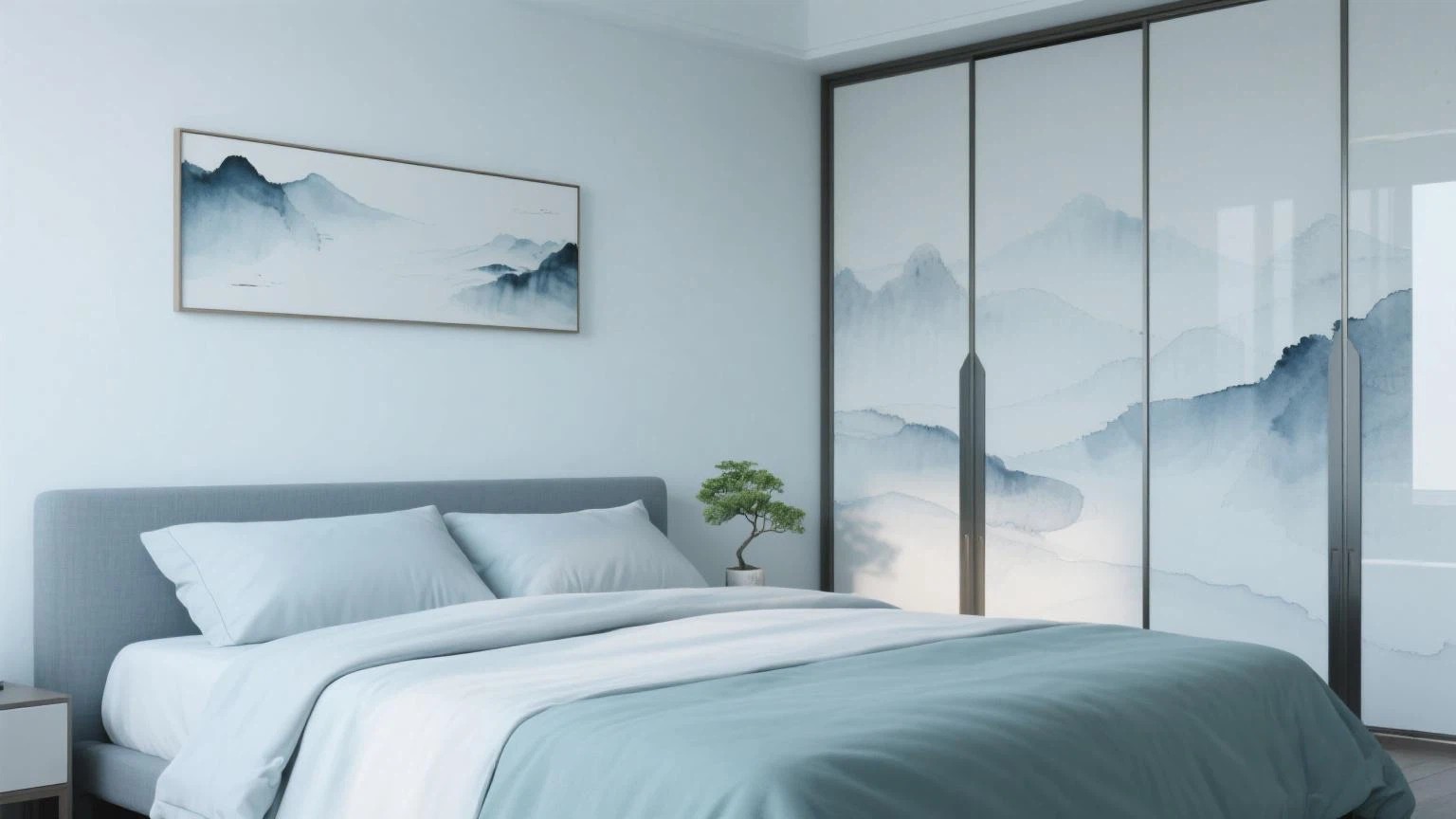
Decorations and plants in the bedroom are "micro-adjusters" that can optimize emotions and sleep without changing the hard furnishings. This article focuses on mirrors, paintings, and greenery, providing placement principles and pitfalls to avoid that respect tradition while being practical.
1. Mirrors: Usage and Direction
- Principle: Mirrors should not directly face the bed to avoid nighttime reflections and psychological disturbances.
- Placement: Side walls are better than facing directly; built-in wardrobe mirrors are preferable to large exposed mirrors.
- Nighttime Covering: Prepare curtains or magnetic covers, and conduct a two-night covering test before finalizing the plan.
- Multi-faceted Mirrors: Try to avoid complex reflections to maintain the bedroom's "low-stimulation" characteristic.
2. Paintings: Theme and Material
- Content: Themes of tranquility, nature, and softness are more conducive to sleep; avoid sharp, horrifying, and high-contrast subjects.
- Size: Medium to small sizes are preferable, avoiding large pieces facing the bed that create a sense of "pressure".
- Material: Matte framing is better than highly reflective glass to reduce direct light stimulation.
3. Greenery: Types and Quantity
- Selection: Focus on small plants that are shade-tolerant, easy to care for, and have a light fragrance (such as pothos, snake plant, peace lily, etc.).
- Quantity: 1-2 pots are sufficient; avoid large quantities and dense arrangements that lead to moisture and odor accumulation. Plants consume very little oxygen at night, but a large number of plants are not suitable for the bedroom.
- Placement: On side walls or near windows, not close to the head of the bed or bedside; avoid branches and leaves pointing towards the bed to prevent a "pointing feeling".
4. Aromatherapy and Humidification: Moderation and Safety
- Aromatherapy: Light scents and short-term use are advisable; avoid strong odors that affect sleep.
- Humidifiers: Pay attention to cleanliness and balance between dry and wet to prevent mold and dampness.
5. Traditional Objects: Respect and Rationality
- Gourd, crystals, etc.: Can serve as psychological stabilizers and decorative points; position them primarily on side walls and corners, avoiding placement above the bed.
- Wind chimes, water features: Not suitable for the bedroom to avoid noise and humidity.
6. Zoning Placement Principles (Three Steps)
1. Keep the head of the bed simple: Do not stack decorations or place strong reflective objects.
2. Lighten the foot of the bed: Small paintings or fabric can be placed, avoiding large mirrors.
3. Soften corners: Use plants or fabric to round sharp lines, enhancing the sense of safety.
7. Self-Assessment and Checklist (10 Items)
1. Mirrors do not directly face the bed, or can be easily covered at night.
2. Paintings have tranquil themes, soft colors, and are framed in matte.
3. The number of plants is moderate (1-2 pots) and without strong fragrances.
4. Plant placement is not near the head of the bed or bedside, avoiding a "pointing feeling".
5. Aromatherapy is light and short-term, not strong before sleep.
6. Humidifiers are cleaned regularly, with moderate humidity and no moldy smell.
7. Do not use wind chimes or water features that may disturb sleep.
8. The placement of traditional objects is reasonable, not above the bed.
9. Surfaces are tidy, with low visual load.
10. Nighttime reflections and light leaks have been assessed and addressed.
References and Source Notes
- "The Ten Books of Yang House": Emphasizes the stability of the main position and avoiding direct confrontations; the arrangement of decorations and plants should "not disturb the main position, nor create sharp kills".
- "The Green Bag Classic" and various annotations: "Sitting solidly and facing emptiness" and the four-symbol pattern are used to explain the bedroom's "back support, open front", with decorations serving to buffer and shield, avoiding destructive shapes.
- "The Book of Burial" (Guo Pu): The principle of "Qi riding the wind disperses, boundaries stop water" is used for indoor "movement line buffering, wet area boundaries" settings, stabilizing the bedroom's energy field.
- "The Yellow Emperor's House Classic": Emphasizes hygiene and comfort in living spaces; the principles of "dehumidification and cleanliness, odor control and wet area management" in this article stem from this overarching guideline.
- "The Eight Houses Mirror", "Shen's Xuan Kong Studies", "Xuan Kong Feng Shui": If decorations and plants involve Qi theory (life hexagram/flying stars/lucky chart), they need to be determined according to orientation and timing; this article focuses on form and engineering measures, with Qi theory explained in another text.
- "The Five Secrets of Geography", "The Dragon's Tremor Classic", "The Doubtful Dragon Classic": The five essentials of form and the general principles of orientation provide insights into the volume, material, and position of decorations; "wet area control and odor management" belong to modern indoor experience.