
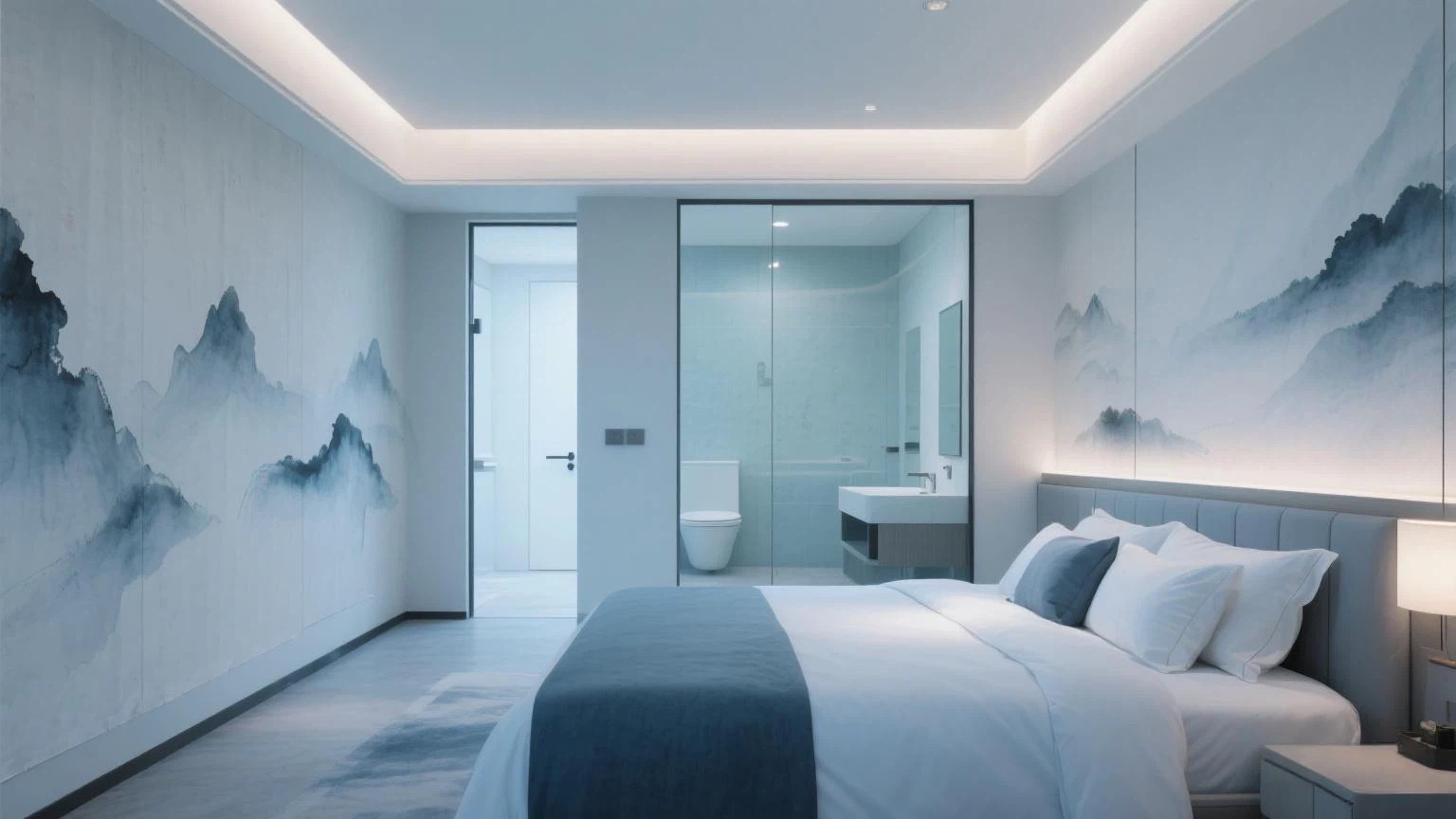
The convenience of a master bedroom with an attached bathroom is obvious, but it also brings issues such as humidity, noise, and door conflicts. This article addresses the door position, dry and wet area separation, and ventilation and dehumidification, proposing a step-by-step breakdown and renovation priorities.
1. Pros and Cons of Master Bedroom with Attached Bathroom
- Advantages: Convenient living, short movement lines, stronger privacy.
- Risks: Overflow of humidity and odors, direct conflict between door position and bed, nighttime noise and light leakage, cleaning and maintenance costs.
Conclusion: Convenience and comfort need to be balanced, achieving "more benefits than drawbacks" through door position and wet area management.
2. Relationship Between Door Position and Bed Position (Highest Priority)
- No direct conflict: The bathroom door should not form a straight line with the bed; if necessary, misplace the bed or set up a buffer zone.
- Visual obstruction: Add a screen or low cabinet outside the door to weaken the direct line of sight; set up a towel rack or half-height objects inside the door.
- Door direction: Adjust the door opening direction or add a curtain to reduce direct visual and airflow conflicts.
3. Dry and Wet Area Separation and Partitioning
- Glass partitions and half walls: Separate the wet area (shower) from the dry area (washbasin) to reduce water vapor overflow.
- Waterproofing and floor drains: Strengthen the waterproof layer and floor drain capacity to avoid water seepage and odor backflow.
- Mats and water barriers: Set up water barriers and absorbent mats at the door to create a physical buffer.
4. Ventilation, Dehumidification, and Odor Management
- Independent ventilation: Install independent ventilation with a delay function to continuously expel water vapor and odors after bathing.
- Dehumidification and drying: If necessary, equip a dehumidifier to maintain humidity balance in the bedroom and attached bathroom.
- Cleaning and maintenance: Regularly clean floor drains, ventilation outlets, and towel racks to reduce odor sources.
5. Nighttime Safety and Light Control
- Light leakage treatment: Add sealing strips or soft curtains to the door seams to keep the bedroom dark at night.
- Noise control: Use soft close door mechanisms and buffer strips to reduce noise when opening and closing doors at night.
- Nighttime guidance: Use low-position, low-intensity guiding lights to ensure no disturbance to cohabitants.
6. Three-Level Solutions (Based on Cost and Conditions)
- Level A (Best): Misplaced door position, formed glass partition, independent ventilation and dehumidification in place.
- Level B (Renovation): Screen/low cabinet buffering, door direction adjustment, water barriers and sealing strips improved.
- Level C (Soft Decoration): Door curtains and nighttime coverings, absorbent mats, enhanced cleaning and maintenance.
7. Self-Assessment and Inspection Checklist (10 Items)
1. The bathroom door does not directly conflict with the bed, or there is a buffer zone for obstruction.
2. The door direction is reasonable, and the line of sight and airflow do not excessively pass through.
3. Wet and dry areas are separated, and shower water vapor does not overflow.
4. Waterproofing and floor drains are good, with no odor backflow.
5. Independent ventilation operates with a delay, expelling humidity and odors in a timely manner.
6. If necessary, a dehumidifier is provided to maintain humidity within a comfortable range.
7. Light leakage and door seam treatments are in place, keeping the room dark at night.
8. Noise control is good, and opening and closing doors at night do not disturb others.
9. There are low-position guiding lights for nighttime, ensuring a safe path.
10. Regular cleaning and maintenance reduce sources of odors and bacteria.
References and Source Notes
- "Ten Books on Yang House": Emphasizes the stability of the main position and avoidance of direct conflicts; the relationship between the bathroom door and bed position prioritizes not disturbing the main position.
- "Qing Nang Jing" and various annotations: The principle of "sitting solid and facing void" and the four-symbol pattern is used to explain the bed's "backing and openness"; door position and movement lines maintain the situation through buffering and obstruction.
- "Book of Burial" (Guo Pu): The principle of "Qi riding the wind disperses, boundary water stops" is used for the indoor settings of "door position buffering, water barriers, and partitions" to stabilize the bedroom's energy field.
- "Huangdi's House Classic": Emphasizes hygiene and comfort in living spaces; the overall framework of "ventilation, dehumidification, dry and wet area separation, and cleaning maintenance" originates from this.
- "Eight Houses Mirror", "Shen's Xuan Kong Studies", "Xuan Kong Feng Shui Studies": The door position and bed position of the master bedroom with an attached bathroom also need to be judged in conjunction with the principles of Qi (life hexagram/flying stars/operation plate); this article focuses on form and engineering measures, while the principles are explained in another article.
- "Five Secrets of Geography", "Han Long Jing", "Yi Long Jing": The five essentials of form and the overall principles of orientation provide insights into movement lines and door positions; indoor "avoiding direct conflicts and setting buffer zones" is part of the foundation of form.