
What does Xuan Kong Flying Stars talk about? Simply put, it considers both "time" and "space": every 20 years, a new "period" begins, and during this time, the "period star" enters the center. By combining the mountain direction of the house, we can see where the stars fly in the nine palaces to determine where is prosperous and where is weak.
How are the "three plates" divided? The period plate represents time, the mountain plate looks at population and stillness, and the direction plate examines wealth and movement. When reading the chart, do not focus on just one plate; all three should be considered together, similar to how a doctor checks multiple indicators for cross-confirmation.
Should we fly in order or in reverse? The core idea is to fly the numbers from the center to other palaces in sequence. Depending on the mountain direction, there may be a forward or reverse flight, but introductory materials usually provide a fixed starting point and flight method. First, draw the chart according to a unified standard, and do not get caught up in oral transmission differences from the start.
What is "prosperous mountain and prosperous direction"? Simply put, it means that the mountain position has prosperous stars and good population, while the direction position has prosperous stars and good wealth; if the mountain is prosperous but the direction is not, or the direction is prosperous but the mountain is not, consider methods like "combining ten" or "collecting the mountain and eliminating the killing" to adjust based on form and theory.
What is the path for beginners? First, determine the period (for example, in 2024, we are still at the tail end of the eighth period, entering the ninth period in November 2024), then measure the sitting direction to determine the mountain direction, and according to unified rules, place the period stars in the center and fly out the three plates to obtain the house destiny chart. Then see where the prosperous stars fall in relation to the functional areas of the house (door, bedroom, kitchen/living room), and finally think about how to seek good fortune and avoid misfortune.
Common pitfalls? Only memorizing a few terms without drawing charts; only looking at theory without considering form (surrounding mountains/water/roads); treating flying stars as a static nine-grid without considering time changes. In the beginner stage, first practice the line of "determining the period - determining the sitting direction - flying out the three plates - observing prosperous stars - falling into functional areas" before discussing improvements.
Core concepts simplified
- Three Yuan Nine Periods: Time is divided into nine "periods", each lasting about 20 years, with the current period's "period star" entering the center as the main influencing factor.
- Three Plates: Period plate (time plate), mountain plate (sitting plate, looking at population and stillness), direction plate (looking at wealth and movement), which need to be considered together when reading the chart.
- Forward/Reverse Flight: After determining the sitting direction, decide the order of flying stars; commonly used materials will provide unified rules for forward and reverse flight and starting points.
- Prosperous Mountain and Prosperous Direction and Combining Ten Method: The ideal state is for both mountain and direction to be prosperous; when not ideal, the combining ten method can be used for balance, or adjustments can be made based on the form.
- Collecting the Mountain and Eliminating the Killing: Through form and layout, make the mountain plate more convergent and the direction plate more energetic, often in conjunction with external water mouth observations.
Beginner drawing process (simplified example)
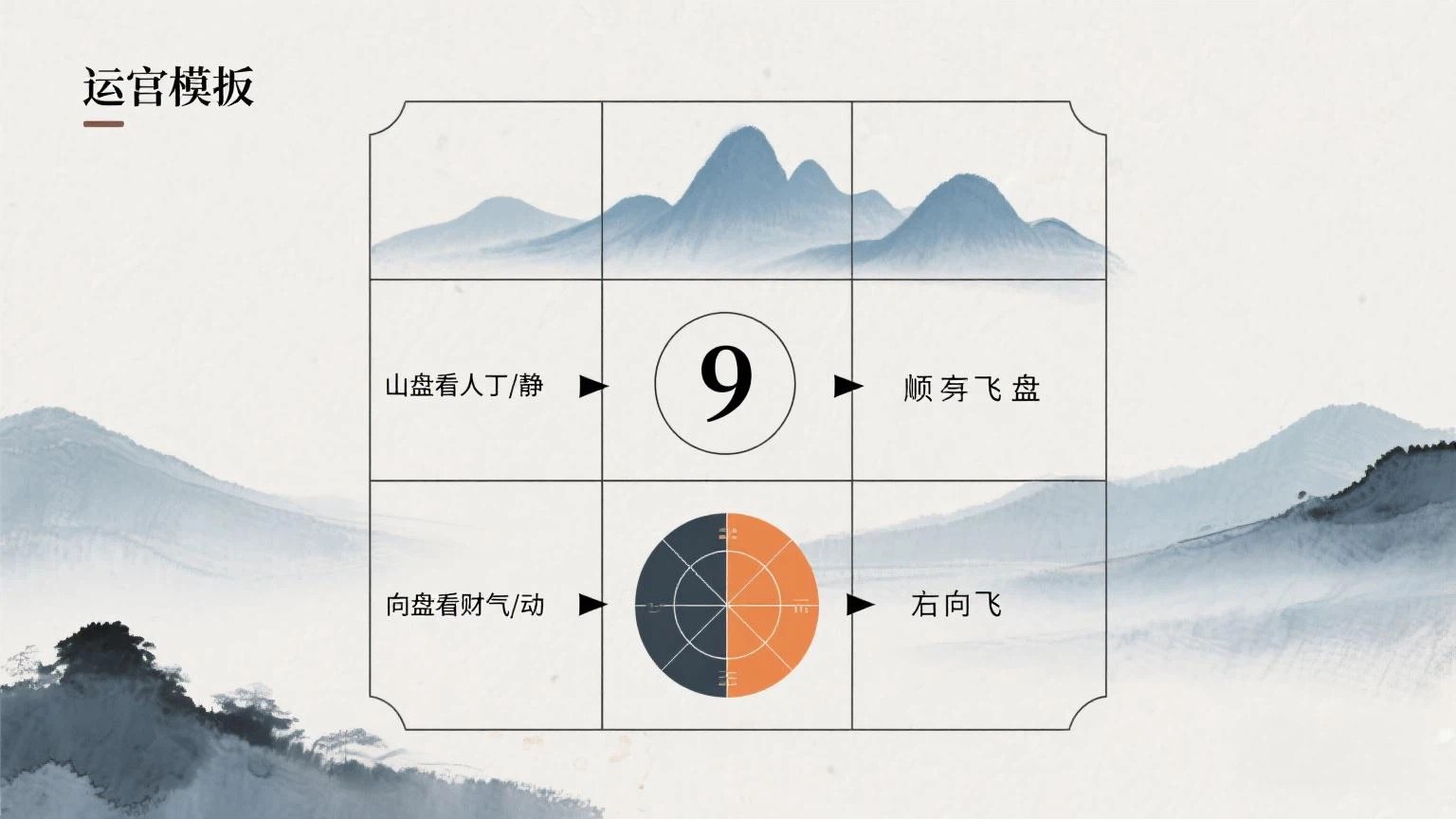
1. Period Plate: Place the current period star in the center (e.g., for the ninth period, mark the center with "9"), and fill in each palace according to the standard flight sequence.
2. Mountain Plate: Take the stars from the period plate in the "sitting direction" and place them in the center, determining forward or reverse flight based on the yin-yang of the sitting direction, and fill in each palace.
3. Direction Plate: Take the stars from the period plate in the "direction" and place them in the center, determining forward or reverse flight based on the yin-yang of the direction, and fill in each palace.
4. Preliminary Interpretation: Observe the stars in the mountain plate and direction plate at key points such as the entrance, bedroom, kitchen, etc., to assess the inherent situation of population and wealth.
Beginner Case Study (Teaching Example)
- Situation: Newly built residence, entering the ninth period (2024–2043). The compass indicates "sitting north facing south" (illustrative).
- Steps:
1) Period Plate: Mark the center with "9";
2) Mountain Plate: Take the stars from the period plate in the sitting direction and determine the flight based on the yin-yang of the sitting direction;
3) Direction Plate: Take the stars from the period plate in the direction and determine the flight based on the yin-yang of the direction;
4) Key Interpretation: If the direction plate at the entrance has prosperous stars and the water mouth is reasonable, then the wealth situation is better; if the mountain plate in the bedroom has prosperous stars and is still, then the population situation is better. If "the mountain is not prosperous, and the direction is not prosperous", consider using the "combining ten method" for balance or "collecting the mountain and eliminating the killing" for adjustments.
- Note: This case study is a process demonstration; complete flying stars require rigorous sitting direction determination, yin-yang judgment, and chart deduction.
Common Questions
- How to remember the flying star sequence? Beginners can use standard sequences and template charts to avoid calculation errors.
- Why separate mountain plate and direction plate? Traditionally, the mountain represents population, and water represents wealth; the division of mountain and direction helps to judge the different focuses of population and wealth.
- How to adjust if not prosperous? First, look at the focus on "population/wealth", then consider whether the combining ten method and environmental form (water out, mountain in) match.
References
- "The Original Meaning of Xuan Kong" by Jiang Dahong (Qing Dynasty, Kangxi period, around 1660–1700) — Basics of Three Yuan Nine Periods and Xuan Kong Theory
- "Shen's Xuan Kong Studies" by Shen Zhuren (Qing Dynasty, Guangxu period, around 1875–1908) — Production of Flying Stars Three Plates and Forward/Reverse Judgment
- "Five Secrets of Geography" by Zhao Jiufeng (Qing Dynasty, Qianlong period, around 1740) — Sitting Direction Judgment and Compass Application (Supplementary Reference)