
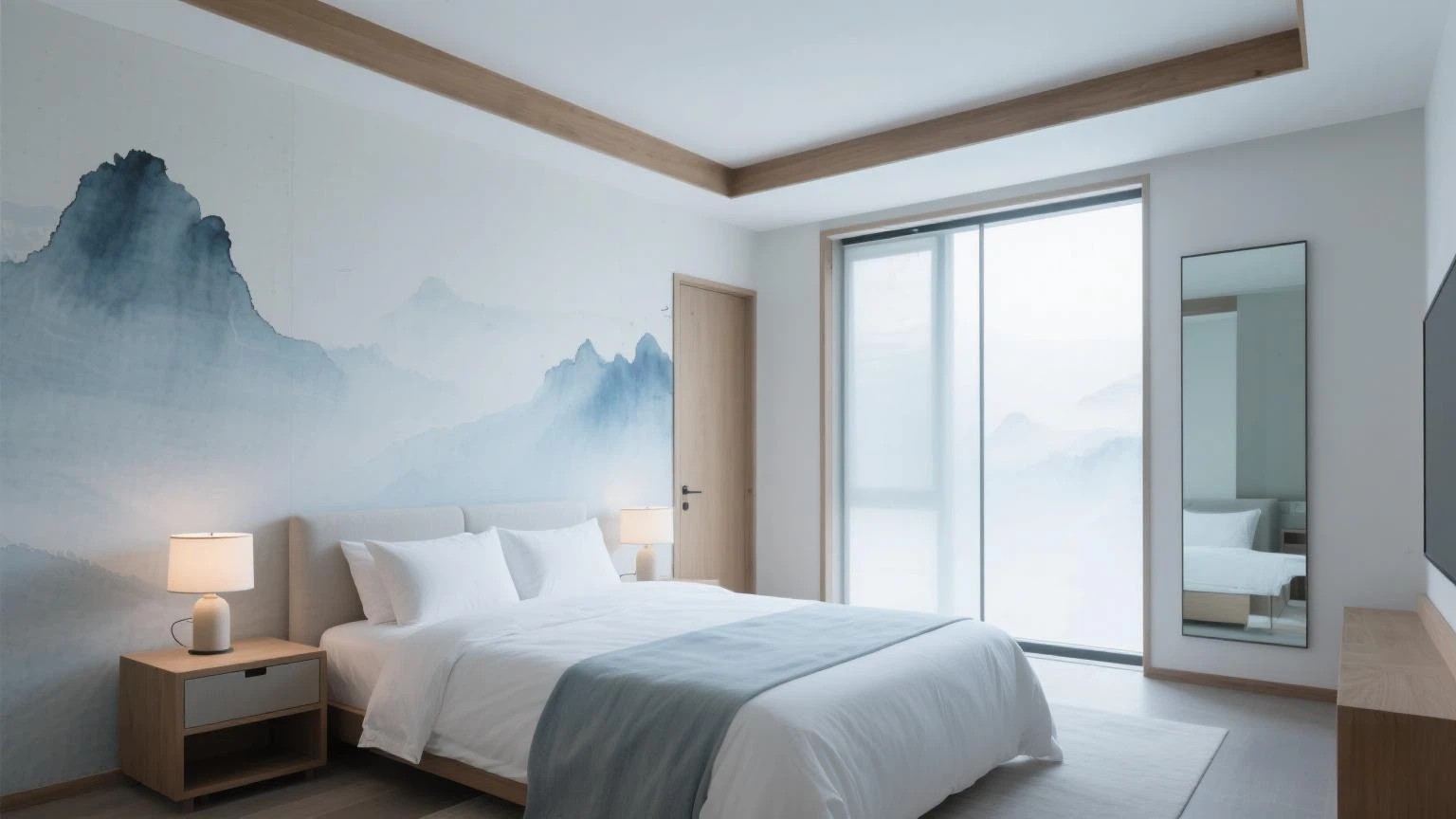
In traditional home concepts, the bedroom is not only a place for sleep but also the "core of energy" for nurturing the spirit and restoring energy. One's daily state can often be glimpsed from the order, light, materials, and privacy boundaries of the bedroom. This article outlines the basic principles and common misconceptions of bedroom feng shui in a general way, providing actionable solutions to lay the groundwork for subsequent topics (bed placement, furniture, decorations and plants, lighting and colors, master bedroom with attached bathroom).
1. Why the Bedroom is the Core of Home Energy
1) Place for Rest: The First Priority for Sleep and Physical and Mental Adjustment
The primary function of the bedroom is to "allow people to sleep soundly." Any factors that interrupt sleep—noise, excessive light, mirror reflections, heavy objects overhead, clutter, and excessive stimulation—should be prioritized for elimination. The significance of feng shui can be practically applied here: through layout and material selection, reduce nighttime stimulation and unease, allowing the body and mind to return to a stable state.
2) Privacy Boundaries: Psychological Safety and Spatial Hierarchy in the Bedroom
Psychological safety comes from "being visible and protected." Being able to see the bedroom door from the bed, but not being directly aligned with it, is a principle emphasized by most schools as the "control position" principle (see the main position in "Three Essentials of Yang House," where the shape of the mountain is "sitting solid and facing empty"); at the same time, the movement lines and storage in the bedroom should be simplified and concealed as much as possible to reduce visual load and the possibility of disturbance.
3) Energy Distribution: The Impact of Airflow, Light, and Materials on Emotions and States
During the day, soft natural light is preferred, while at night, dimmable lighting is suitable; airflow should be steady, and temperature and humidity should be moderate; materials and textures should be warm and not primarily strong reflective or overly cold and hard. The bedroom should be a low-stimulation space that allows emotions to gradually calm down.
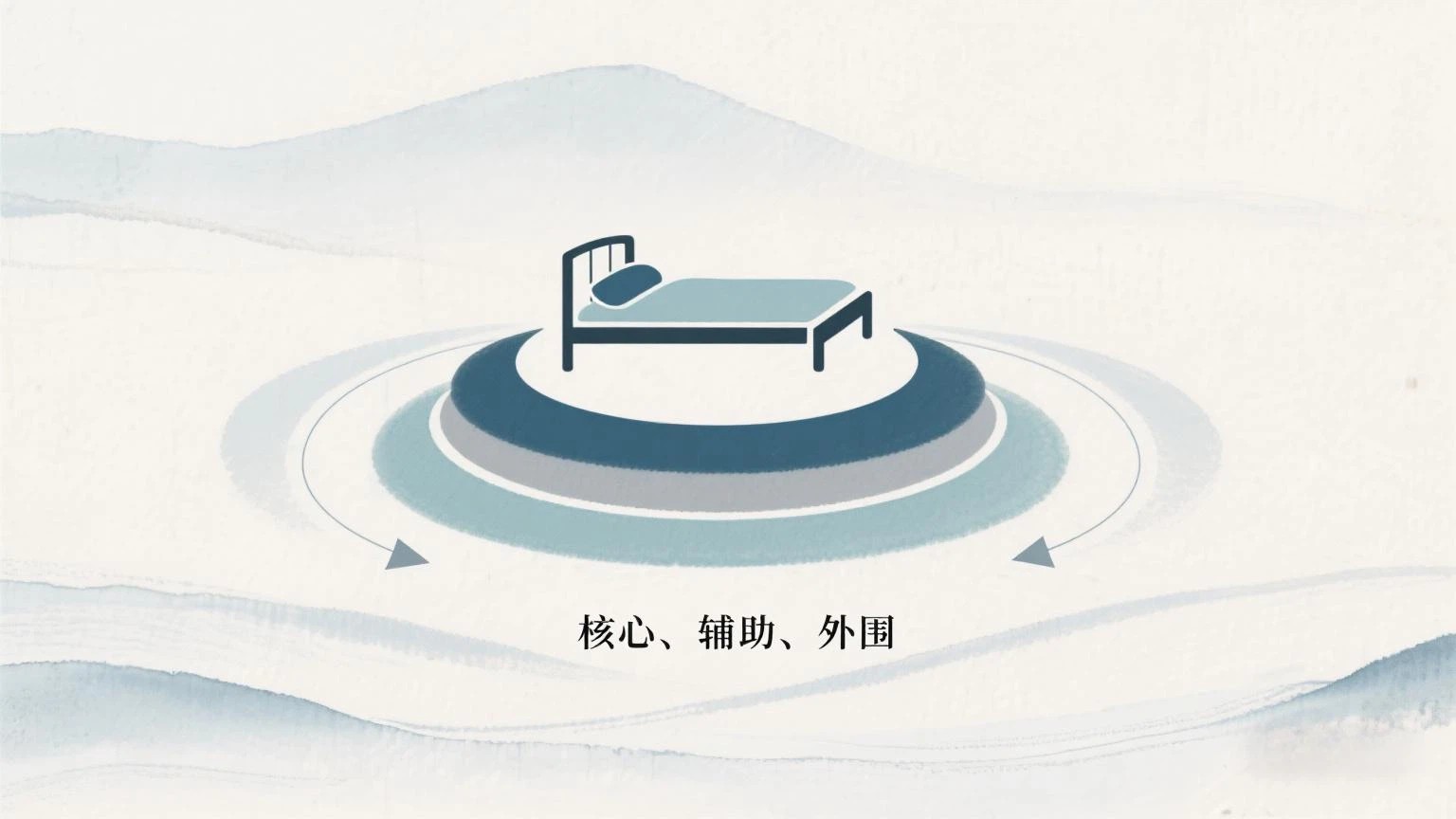
2. Five Basic Principles of Bedroom Feng Shui
Method Description (Focusing on Shape and Mountain):
This article primarily focuses on shape and mountain (the shape family), paying attention to the spatial order and living experience of "dragon, cave, sand, water, and direction"; the principles of energy (Eight Houses, Xuan Kong) will be explained in another article, and this article will not elaborate on the auspicious and inauspicious judgments of direction and time.
1) Control Position
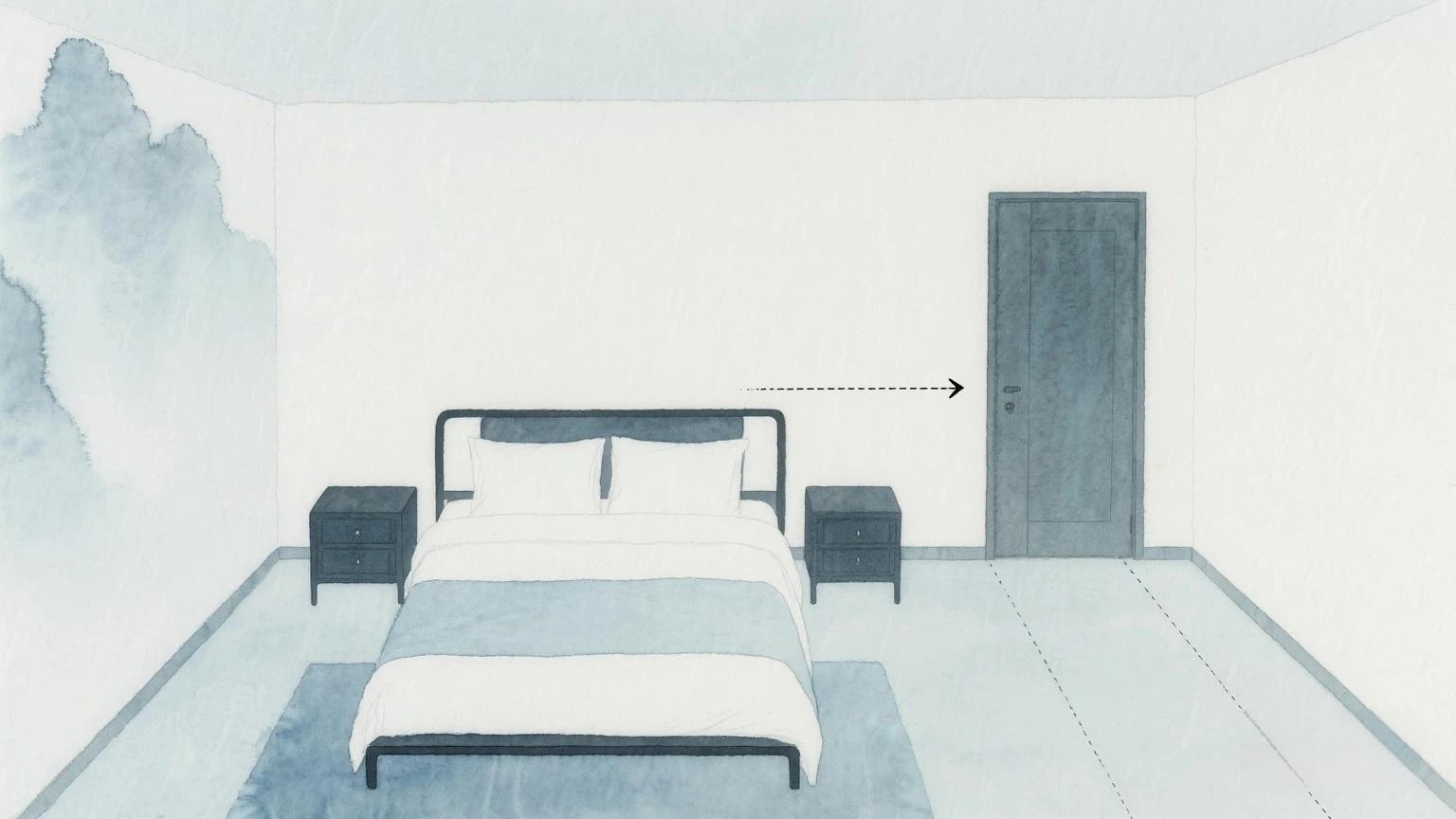
From the bed, one can see the bedroom door, but the bed position does not form a direct line with the door (the shape and mountain avoid direct confrontation, taking a gentle transition). The head of the bed should be against a wall or have a solid headboard to enhance the sense of security and support ("having support" means sitting solid and facing empty).
2) Movement Lines and Order
The movement lines in the bedroom should be clear and should not cross the core resting area at the foot of the bed; storage should be as concealed as possible, and surfaces should minimize scattered decorations and sharp objects to reduce visual and emotional load.
3) Layered Lighting
Use soft natural light during the day; at night, primarily use blackout curtains and low-intensity lighting, forming a layered structure of "ceiling light (used sparingly)—bedside lamp—ambient light—night guide light," avoiding direct light on the bed (the balance of yin and yang is the general principle, see "The Yellow Emperor's Housing Classic").
4) Soundproofing and Safety
Avoid overhead beams and heavy objects (chandeliers, fans, air conditioning units) above the bed to prevent psychological pressure (the shape family is cautious about this; there should be no beams or heavy objects hanging above the bed); try to control noise from windows and light leakage from door gaps, and if necessary, add sealing strips and heavy curtains.
5) Materials and Textures
Choose matte wall surfaces, soft fabrics, and warm wood materials, reducing strong reflections from mirrors and metals; bedding should be skin-friendly and breathable, with a comfortable texture that aids sleep.
3. Common Misconceptions and Risk Warnings
Door Facing Bed
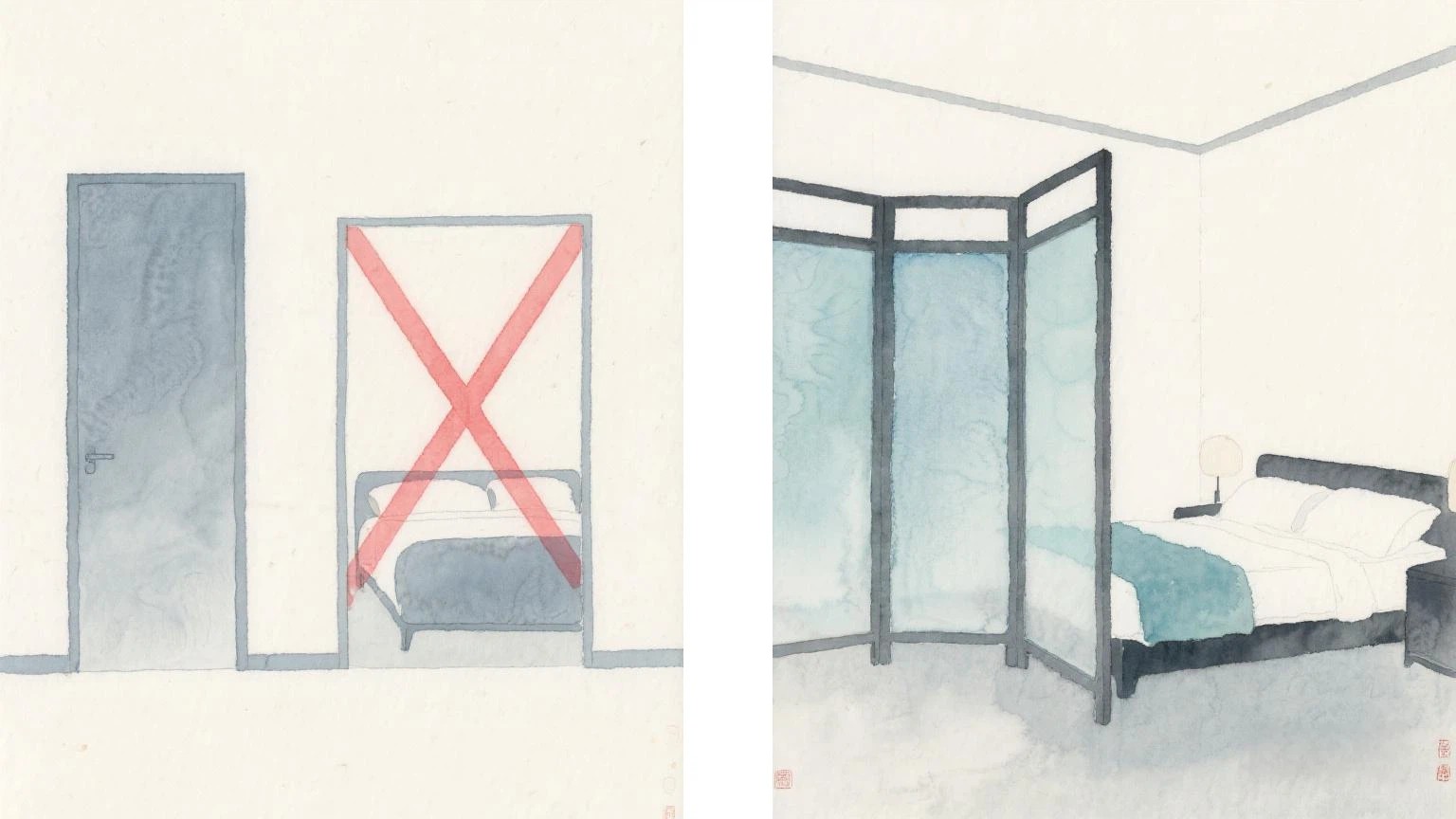
When the door and bed form a direct line, it affects privacy and the sense of safety (the shape and mountain emphasize that "qi disperses with wind, and boundaries stop with water" as a general principle, avoiding direct confrontation in yang houses). Solution: Use a screen or low cabinet to create a buffer zone, slightly move or rotate the bed position to achieve misalignment, or adjust the door leaf and curtain to reduce the feeling of direct confrontation (modern engineering solutions require separate assessment with energy principles).
Mirror Facing Bed
When a mirror faces the bed, reflections and psychological disturbances are significant. Solution: Move the mirror to a side wall or inside a wardrobe door; use curtains/folding screens/magnetic covers at night for遮挡, and conduct a two-night遮挡 test before finalizing the solution.
Bed Head Not Supported
When the bed head is unsupported or only against a window, it can easily cause unease and fright. Solution: Ensure the bed head is against a wall or use a solid headboard, and avoid placing it close to a window.
Overhead Beams
Overhead beams, chandeliers, or fans above the bed increase the feeling of oppression (the shape family is cautious about this). Solution: Lightly decorate or use false ceilings to weaken the visual impact, adjust the light position, and avoid heavy objects directly above the head.
Bed Against Window
Being too close to the window can easily lead to noise and light disturbances at night. Solution: Maintain a reasonable distance from the window, use double-layer curtains (sheer + blackout), and if necessary, add soundproofing and sealing treatments.
4. Prioritization of Choices in Limited Spaces
Privacy and Safety > Sleep and Light > Storage and Function.
When space is limited and conditions are complex, prioritize ensuring the control position and avoiding direct confrontation with the door, then address mirror and ceiling issues, and finally optimize storage and decorations. For small bedrooms, sloped beams, and conflicts with attached bathroom doors, it is recommended to adopt the B solution of "misaligned placement, screen buffering, and nighttime遮挡."
5. Actionable Resolution Strategies
- Three-Step Method: Identify (draw a diagram/take a photo from the bed perspective) → Buffer (screen/low cabinet/fabric) → Substitute (move/rearrange).
- Night Testing Method:遮挡 light and mirrors for two nights, record sleep and emotional feedback, and make adjustments if the effects are significant.
- For Small Units: Merge functions (e.g., dressing table and desk), store mirrors inside wardrobe doors, and use low cabinets or plants to create flexible buffers.
6. Self-Assessment and Checklist (10 Items)
1. Can see the door from the bed, but not directly aligned with it.
2. The head of the bed is stable, supported by a solid wall or headboard.
3. No overhead beams, chandeliers, fans, or air conditioning units directly above the head.
4. Mirrors do not directly reflect the bed, or can be easily遮挡 at night.
5. Double-layer curtains (sheer + blackout), dimmable at night.
6. The bedroom movement lines are simple, not crossing the core resting area at the foot of the bed.
7. Sources of noise and light leakage have been assessed and addressed (windows/door gaps/mirrors/screens).
8. Lighting is layered reasonably, bedside lamps are dimmable, and ambient light is soft.
9. Materials and textures are warm, and visuals are not overly stimulating.
10. If there is an attached bathroom, considerations for door misalignment, wet and dry separation, and ventilation/dehumidification have been made.
7. Analysis of Myths (Respecting Tradition, Considering Practicality)
- Regarding the sayings of "north-south sleeping direction" and "bed head facing west": these can serve as traditional references, but the energy system (Eight Houses, Xuan Kong) needs to be combined with the house direction, operation chart, and personal life chart for comprehensive judgment; this article focuses on shape and mountain and environmental practicality, prioritizing actual comfort, noise, and light control, and recommends using sleep test results as the final basis.
- Can mirrors face the bed: Different schools have varying opinions; the shape family prioritizes "avoiding strong reflections and psychological disturbances" (indoor shape experience, few direct texts in ancient books), recommending first conducting遮挡 tests, and if it affects sleep, then move or遮挡.
8. Conclusion and Series Preview
The bedroom is the core of home energy, and its practical path is not mysterious: achieving a balance between control position, movement line order, layered lighting, soundproofing safety, and material texture. In the next article, we will start with "detailed explanation of bed placement," addressing specific issues of door facing, mirror facing, and overhead beams, and providing eight strategies and diagrams for resolving issues in limited spaces.
References and Source Explanations
- "Ten Books on Yang House": Proposes the "three essentials" of yang house—door, main position, stove; the main position (bed) should have support and avoid direct confrontation, and the principle of control position is derived from this.
- "Qing Nang Jing" and various annotations from the shape family: The general principle of shape and mountain emphasizes "sitting solid and facing empty" and the four-symbol pattern of "front Zhuque, back Xuanwu, left Qinglong, right Baihu" to deduce the bed's "support and openness in front."
- "Book of Burial" (Guo Pu): "Burial is to ride the life energy. Qi disperses with wind, and boundaries stop with water." The shape family uses this as the general principle of "avoiding direct confrontation and taking a gentle approach," which translates to yang houses as "bed placement avoiding direct confrontation with the door."
- "The Yellow Emperor's Housing Classic": Emphasizes that residences should adjust yin and yang, obtain suitable lighting and ventilation, and focus on "peaceful living" and harmony of body and mind; the "layered lighting" in this article is applied in modern environments based on this general principle.
- "Eight House Mirror," "Shen's Xuan Kong Studies," "Xuan Kong Feng Shui Studies": The energy system needs to combine life charts, sitting directions, and operation charts (temporal dimensions) to judge the auspiciousness of directions.
- "Five Secrets of Geography," "Han Long Jing," "Yi Long Jing": The five essentials of shape law are "dragon, cave, sand, water, direction," as well as the general principle of seeking dragons and sitting solid and facing empty; the avoidance of direct mirror confrontation indoors belongs to modern shape experience, with few direct texts in ancient books, hence explained with the general principles of shape law.